Published: 02.11.2026 | Author: Ray Nicholls | Category: Market Insight
When you hire a CFO, a retained search is usually the safer choice, and on a successful hire it rarely costs more than a contingent one.
It doesn't feel that way at first. Two firms pitch for the same search. One asks for a retainer. The other only gets paid if you hire. The second looks like the lower-risk option: no hire, no cost.
That logic protects you against one risk, which is paying for a search that goes nowhere. It does nothing about the bigger risk, which is hiring the wrong finance leader. This article explains what each model actually rewards, where the cost really sits, and when contingent is still the right call.
How each model works, and what it rewards
The difference isn't really about when you pay. It's about what the firm is paid to do.
A contingent recruiter is in a race. If three firms are working the same role, the one that gets the right CV in front of you first gets paid. The others get nothing. So the sensible move is to be quick: send strong candidates who are available now, and send them before anyone else does.
There's nothing dishonest about that. It's simply what the model rewards. But notice what it doesn't reward. Nobody is paid to spend a week questioning your brief, because that week is time a competitor uses to get ahead.
A retained firm isn't racing anyone. It has the search to itself and is accountable for the result. That changes where the effort goes.
| Contingent search | Retained search | |
|---|---|---|
| When the fee is paid | Only on a successful hire | In stages starting on engagement |
| Exclusivity | Usually none; several firms may work the role | Exclusive to one firm |
| What the firm is rewarded for | Getting a CV to you first | Running a complete, accountable process |
| Who it reaches | Mostly people already on the market | The whole market, including people who aren't looking |
| Who tests the brief | Usually nobody | The search firm, before it goes to market |
Does retained search cost more?
Usually not, if the search ends in a hire. At CFO and Finance Director level, both models normally charge a percentage of the successful candidate's first-year salary. The headline rates tend to sit close together.
What differs is the timing. A contingent fee is paid in one go when someone starts. A retained fee is split into stages. You pay the same amount, just spread across the search.
The only case where contingent is clearly cheaper is when nobody is hired. That's a real benefit, but it's worth being honest about what it means. You've still spent weeks of your own and your investors' time, the role is still empty, and you're starting again.
Some contingent firms do charge a lower percentage. If they do, weigh the saving against the cost of getting the hire wrong, which comes next.
Where the real risk sits
Senior finance hires rarely fail because the candidate was weak. They fail because the brief was quietly wrong from day one.
After placing finance leaders for more than 25 years, this is the pattern I see most. The CFO is good. The interviews went well. Twelve months later, the relationship has broken down, and the reason goes back to before the search started.
It usually looks like one of these:
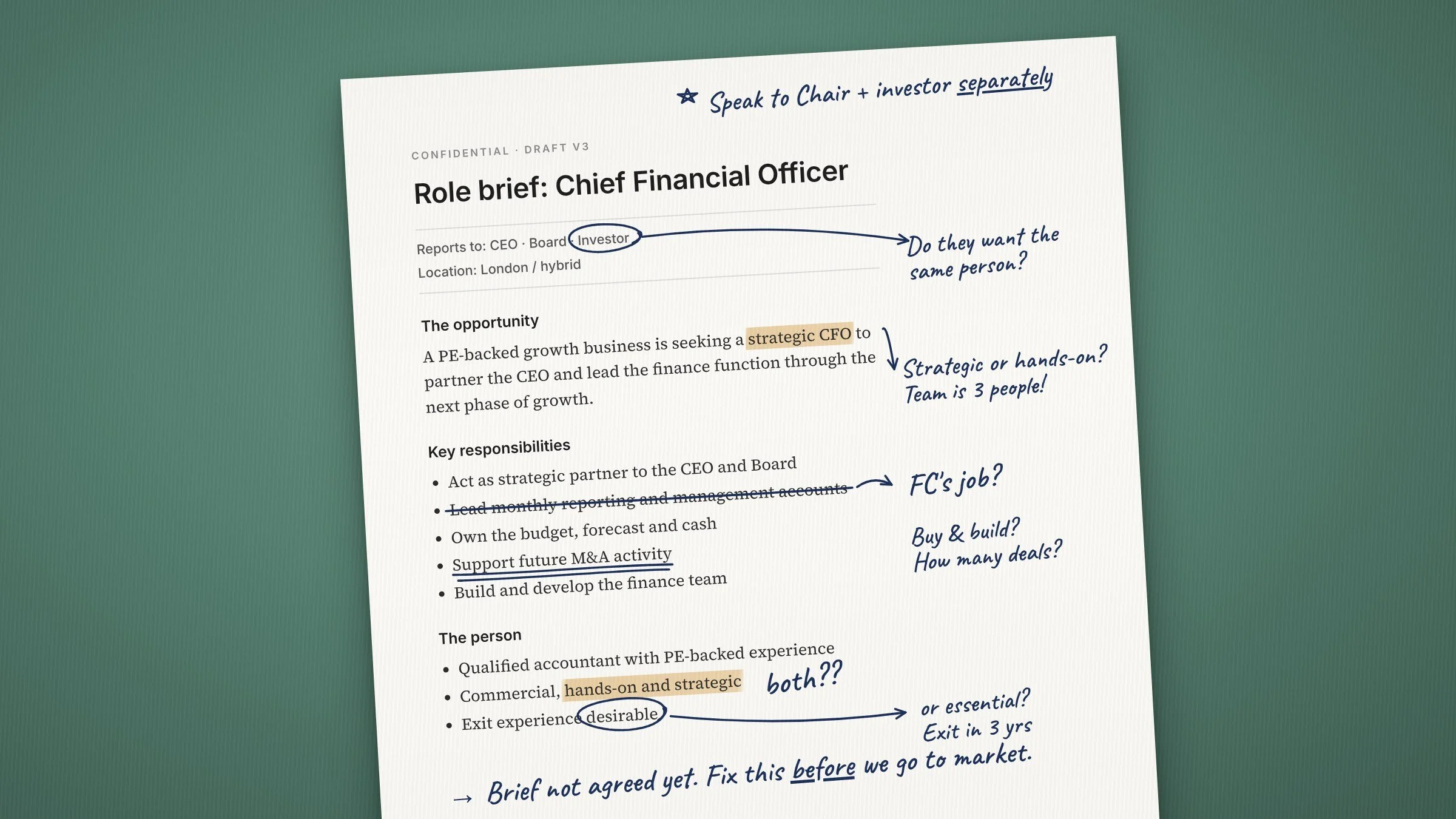
The investors and the CEO wanted different people. The investor wanted someone to sharpen reporting and prepare for exit. The CEO wanted a commercial partner to help grow the business. Both signed off the same job description.
The role described the business as it is, not as it will be. A CFO hired for today's business may not be the one you need in eighteen months, after a buy-and-build or a refinancing.
The scope was bigger, or smaller, than anyone said out loud. The brief said strategic CFO. The reality was a hands-on finance director with a thin team.
None of these is a candidate problem. They're brief problems. And a brief problem can't be fixed by sending better CVs faster.
That's why the safer-looking option often isn't. Contingent protects you from paying for a hire that never happens. Retained protects you from a hire that happens and then goes wrong. Only one of those is expensive.
What a retained search does before any CVs arrive
Most of the value of a retained search is delivered before you see a single candidate. A good one will:
Test the brief with everyone who has a say. That means the CEO, the Chair and the investor, separately. If they want different things, you hear about it in week one, not month twelve.
Agree what success looks like. What should the CFO have delivered after 100 days, a year and at exit? A clear answer makes the shortlist easier to judge.
Map the whole market. The best CFO for your business is often happily employed and not answering job adverts. Reaching them takes time and a reason to talk, which a race for CVs doesn't allow.
Assess candidates against the brief, not against each other. A shortlist of three strong people who fit the situation is worth more than ten who look good on paper.
Stay accountable to the end. Referencing, offer management and the move into the role are part of the job, not an afterthought once the fee is earned.
The first step matters most. A search firm that pushes back on your brief before starting is doing the work you're paying for.
When contingent is the right call
Contingent search works well in some situations, and it's worth being clear about which ones:
The role is well defined and stable. A Financial Controller in an established business with a settled finance team, for example.
The right people are actively looking. If the market is full of strong, available candidates, speed matters more than reach.
There's only one decision-maker. With no investor or board to align, there's less room for the brief to go wrong.
You've hired for this role before and know exactly what good looks like.
The further you move from those conditions, the stronger the case for retained. A first CFO hire, a role shaped by an investment thesis, or a business heading for a transaction all carry the kind of risk that sits in the brief, not the CV.
Questions to ask any search firm
Whichever model you're offered, these questions will tell you what you're really buying:
How will you test the brief, and who will you speak to before going to market?
What will you do if the investors and the CEO want different things?
How much of the shortlist will come from people who aren't actively looking?
Is anyone else working this role? If so, how does that change how you work?
When exactly is each part of the fee due, and what do I get at each stage?
What happens if the hire leaves in the first year?
A firm that answers the first two questions well is worth talking to, whatever its fee model.
The bottom line
On a successful CFO hire, retained and contingent search usually cost about the same. What you get for the money is very different.
Contingent buys speed and access to people already on the market. Retained buys a search firm that is paid to get the brief right, reach the whole market and stand behind the result.
For most senior finance hires in investor-backed businesses, the brief is where the risk sits. So the question isn't which model looks cheaper. It's whether you want someone to fill the role, or someone to challenge it first.
If you're weighing up a CFO or Finance Director search and want a second opinion on the brief, get in touch.
Pitch Hill Partners
Pitch Hill Partners helps investors, boards and CEOs appoint CFOs, Finance Directors, Financial Controllers and FP&A leaders across the UK, on both a permanent and interim basis. If a finance seat has just emptied — or you think it might — we're happy to talk it through.