Published: 04.11.2026 | Author: Ray Nicholls | Category: Problems
When a CFO hire fails in a PE-backed business, the cause is rarely the candidate. More often, the investor, the CEO and the Chair never agreed what the CFO was for.
I've been placing finance leaders for over 25 years. In that time I've seen plenty of senior finance hires go wrong. Very few went wrong because the person couldn't do the job.
The pattern is far more ordinary, and much easier to prevent. The board hires a capable CFO against a brief that was never really agreed. Then it spends the next year wondering why the hire doesn't feel right.
This article explains how that happens, why it stays hidden for so long, and what to do before a search starts so it doesn't happen to you.
Three people, three different CFOs
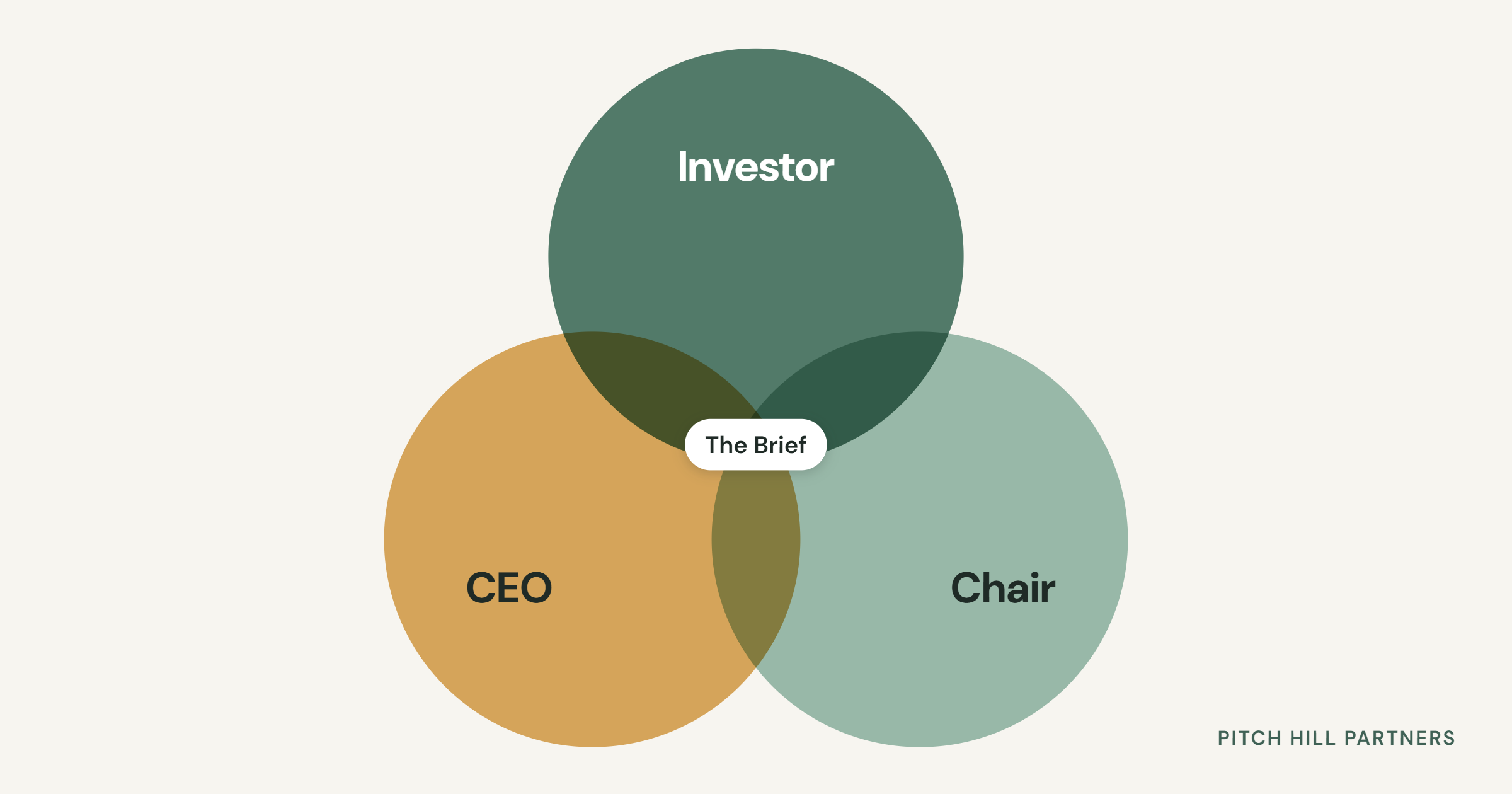
In most PE-backed searches, at least three people have a strong view on the hire. They rarely hold the same view.
The investor is usually thinking about value creation and exit. They want a CFO who can build the equity story, sharpen the numbers that drive valuation, and hold their own in a room of buyers or lenders. Their timeline is the hold period.
The CEO is usually thinking about the business on Monday morning. They want someone to fix a slow month-end, take the lender reporting off their desk and give them numbers they trust. Their timeline is the next two quarters.
The Chair is often thinking about governance and stability. They want a steady pair of hands who will keep the board well informed and won't create surprises. Their timeline is the next board cycle.
None of these views is wrong. Each describes a real need. But they describe three different people, with different instincts, different track records and different ideas of a good first year.
An exit-focused CFO and an operational fixer are not interchangeable. Someone who has spent a career building finance functions from scratch may be uncomfortable fronting a refinancing. The reverse is just as true.
Why the problem stays hidden
The difficulty is that nobody says any of this out loud.
Each stakeholder assumes the others want roughly what they want. The conversations happen in pairs: investor to CEO, CEO to Chair, Chair to investor. Nobody puts all three views on the table together.
So the job spec quietly tries to be all three. It asks for strategic, commercial, hands-on, exit-experienced, a strong operator and a natural board presence. It reads well, and everyone signs it off because they can see their own priority in it.
The search then goes well. That's what makes this so hard to spot. A broad brief attracts a strong shortlist. Each stakeholder meets candidates, finds someone they like and assumes the others liked them for the same reasons. An offer is made and accepted. Everyone is pleased.
Nothing has gone wrong yet. The disagreement has simply been postponed.
Month six: when the cracks appear
The postponed disagreement usually surfaces around six months in.
By then the new CFO has made choices about where to spend their time. Those choices reflect the person they are and the stakeholder they connected with most during the process. Often that's whoever they will work alongside every day.
Say the CFO has thrown themselves into fixing the close, rebuilding the team and tightening controls. The CEO is delighted. The investor, meanwhile, is asking why the value creation plan hasn't moved and why the board pack still doesn't tell the story they need for the next refinancing.
Or the reverse. The CFO has built a strong relationship with the deal team and is busy on the equity story, while the CEO feels the basics are still broken and nobody is fixing them.
In both cases the CFO is doing exactly what they were hired to do, but only for one of the people who hired them.
The others start to wonder whether they've got the wrong person. That conversation tends to go one way. Confidence erodes, the relationship sours, and within eighteen months the business is back in the market for a CFO.
What strikes me most is how rarely anyone concludes the brief was the problem. The verdict is nearly always about the individual: wrong fit, not strategic enough, too operational. The next search starts with the same unresolved disagreement, and the cycle can repeat.
Usually they didn't hire the wrong person. They hired the right person for a question nobody had finished answering.
Settle the brief before the search starts
I no longer treat misalignment as a risk to manage during a search. It's the first thing to sort out, before the search begins.
The most useful hour in any CFO search is the one where the investor and the CEO sit in the same room, ideally with the Chair, and answer one question together:
What must this person have delivered in 18 months for us to call the hire a success?
Eighteen months is long enough to look past the immediate fires. It's also short enough that the answers have to be concrete. "Strategic leadership" doesn't survive the question. "A refinancing completed and a finance function that closes in five days" does.
Often the honest answers in that room don't match. That's the point. Better to find the gap over a coffee than in a board meeting a year later.
When the answers really do conflict, the board has three sensible options:
Choose. Agree which priority comes first and accept the trade-off. The other need still matters, but it doesn't drive the profile.
Sequence. Put the fix first and the growth agenda second. Bring in an interim to stabilise the function, then hire the permanent CFO for the next phase.
Split. Recognise that the business may need two roles, perhaps a CFO and a strong Financial Controller, not one person trying to cover both.
Any of these beats a spec that quietly asks for everything. Each produces a search with a clear target, a shortlist you can compare fairly and a CFO who knows what they're being judged on.
Five questions to answer before you write the job spec
If you are about to hire a CFO into a PE-backed business, get the investor, CEO and Chair to answer these together, not separately:
What must the CFO have delivered in 18 months for us to call this hire a success?
Is the bigger need right now to fix the finance function or to drive value creation, and which comes first if we can't have both at once?
Who will the CFO really report to day to day, and who will judge their performance?
What events are coming during the hold period, such as a refinancing, an acquisition or an exit, and how much of that should the CFO lead?
If two strong candidates are good at different things, which one would we choose?
The last question is the most revealing. If the three of you would choose different candidates, the brief isn't ready yet.
The hardest conversation comes first
Most advice on CFO hiring is about assessment: better interviews, sharper references, more rigorous testing. All of that matters. But it assumes everyone already agrees on what they're assessing for.
In PE-backed businesses, that assumption is where things go wrong. The hardest conversation in a CFO search, and the most valuable one, happens before the job spec is written.
So here's a simple test. If you asked your investor and your CEO separately what your next CFO is for, would they give you the same answer?
If you're not sure, that's the place to start. It's the conversation I have with every client before a search begins. If it would help to talk it through for a hire you're planning, get in touch.
Pitch Hill Partners
Pitch Hill Partners helps investors, boards and CEOs appoint CFOs, Finance Directors, Financial Controllers and FP&A leaders across the UK, on both a permanent and interim basis. If a finance seat has just emptied — or you think it might — we're happy to talk it through.